Comprehensive and personalized
support that puts your patients first

Once you prescribe DESMODA, your patients are automatically enrolled in the Eton Cares Program® and all the benefits that come with it

Designed to coordinate rare disease access and coverage so patients can start therapy quickly.
$0 Copay for Eligible Patients:
We help ensure patients have access to affordability support, so cost doesn’t delay therapy.
Enhanced Prior Authorization Support to Help Navigate Access:
Through our partnership with CloudTop Health, a HIPAA-compliant access platform, we support insurance verification, prior authorizations, and appeals—coordinating information, tracking progress, and helping patients move to therapy without delays.
Financial Assistance Review:
We evaluate assistance options based on insurance type and eligibility, including $0 copay support, limited free drug options (Quick Start or Bridge) and a Patient Assistance Program (PAP).
Medication Delivery and Therapy-Start Support:
Delivery is coordinated around the patient’s schedule, with guidance on dosing, storage, product use, and refill expectations.
Ongoing Clinical Support:
Patients receive proactive outreach, refill reminders, safety alerts, and pharmacist access, including monthly check-ins after therapy initiation—reducing after-hours calls to your office.
Nurse Ambassador Support:
A dedicated Nurse Ambassador provides clinical education and ongoing support for families needing additional hands-on guidance.
To contact our partners at CloudTop Health:
Phone: 1-833-212-4577
Fax: 1-833-839-2855
Email: etoncares@cloudtophealth.com
Monday–Friday, 9:00 AM–8:30 PM ET
Website: cloudtophealth.com
$0 copay
for eligible patients*
*
Commercially eligible patients can pay $0 per month.
Restrictions, limitations, and/or eligibility requirements may apply.



DESMODA is available only through Anovo® specialty pharmacy. All prescriptions need to be sent directly to Anovo.
E-PRESCRIBE
- Select Anovo #5 for pharmacy to initiate the e-script in EMR system
- Remove geographical radius in search criteria
Resources for you, your practice, and your patients
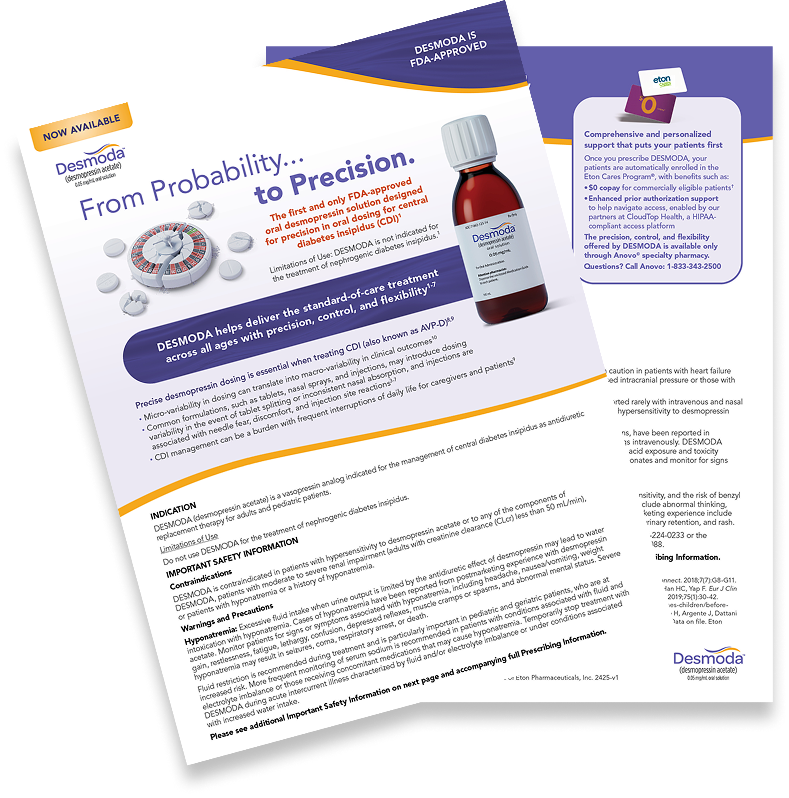
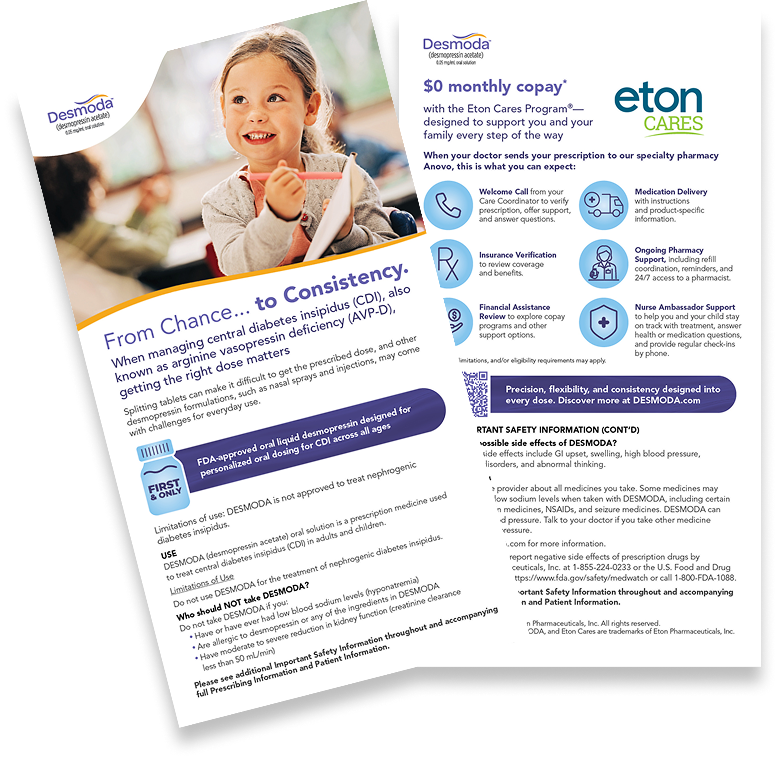
DESMODA Patient Brochure
Use this brochure to help your patients and their caregivers understand the benefits offered by precise, individualized dosing
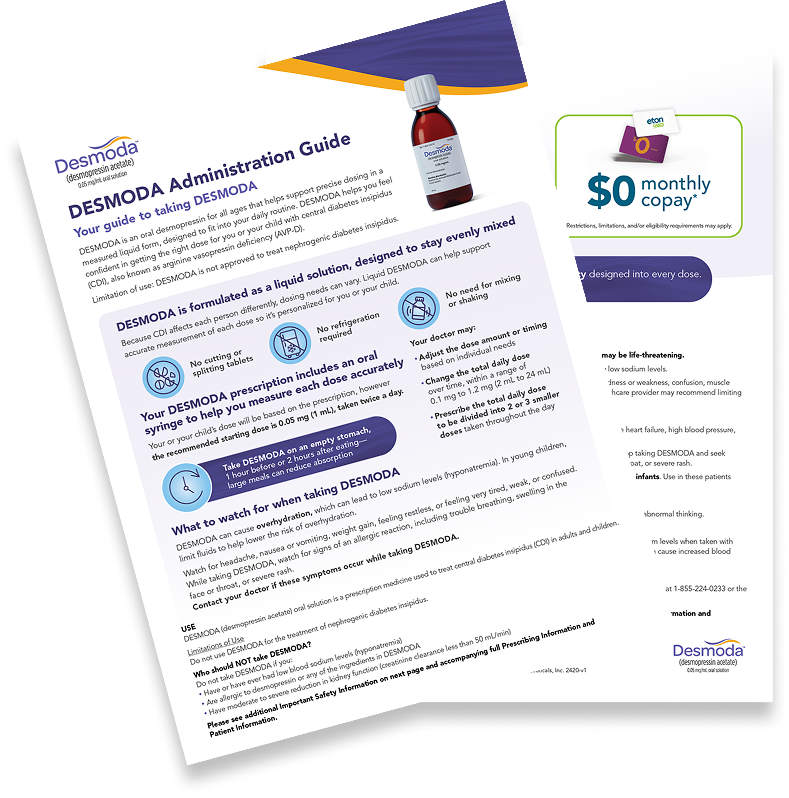
DESMODA Administration Guide
Help your patients and their caregivers learn how to take DESMODA

Advocacy groups
Make your patients and their caregivers aware of these advocacy and education groups to help them navigate CDI.

Histiocytosis Association
The Histiocytosis Association is relevant for patients with CDI caused by a histiocytic disorder.

Pituitary Network Association (PNA)
PNA is a patient advocacy organization that provides education, resources, and support for people with pituitary disorders, including conditions that can lead to CDI.

Raymond A. Wood Foundation (RAWF)
RAWF focuses specifically on hypothalamic-pituitary brain tumors and the lifelong challenges survivors face, including CDI.
Worldwide Adrenal and Pituitary Organizations (WAPO)
WAPO is a global network of patient groups that connects individuals affected by adrenal and pituitary conditions, such as CDI, to education, support, and community worldwide.
Register to receive email updates on DESMODA, request follow-up from a sales representative, or connect with a medical science liaison for clinical and scientific discussion
USE AND IMPORTANT SAFETY INFORMATION
INDICATION
DESMODA (desmopressin acetate) is a vasopressin analog indicated for the management of central diabetes insipidus as antidiuretic replacement therapy for adults and pediatric patients.
Limitations of Use
Do not use DESMODA for the treatment of nephrogenic diabetes insipidus.
IMPORTANT SAFETY INFORMATION
Contraindications
DESMODA is contraindicated in patients with hypersensitivity to desmopressin acetate or to any of the components of DESMODA, patients with moderate to severe renal impairment (adults with creatinine clearance (CLcr) less than 50 mL/min), or patients with hyponatremia or a history of hyponatremia.
Warnings and Precautions
Hyponatremia: Excessive fluid intake when urine output is limited by the antidiuretic effect of desmopressin may lead to water intoxication with hyponatremia. Cases of hyponatremia have been reported from postmarketing experience with desmopressin acetate. Monitor patients for signs or symptoms associated with hyponatremia, including headache, nausea/vomiting, weight gain, restlessness, fatigue, lethargy, confusion, depressed reflexes, muscle cramps or spasms, and abnormal mental status. Severe hyponatremia may result in seizures, coma, respiratory arrest, or death.
Fluid restriction is recommended during treatment and is particularly important in pediatric and geriatric patients, who are at increased risk. More frequent monitoring of serum sodium is recommended in patients with conditions associated with fluid and electrolyte imbalance or those receiving concomitant medications that may cause hyponatremia. Temporarily stop treatment with DESMODA during acute intercurrent illness characterized by fluid and/or electrolyte imbalance or under conditions associated with increased water intake.
Fluid Retention: Desmopressin acetate may cause fluid retention and should be used with caution in patients with heart failure or uncontrolled hypertension. DESMODA is not recommended in patients at risk for increased intracranial pressure or those with a history of urinary retention.
Hypersensitivity Reactions: Hypersensitivity reactions including anaphylaxis have been reported rarely with intravenous and nasal administration of desmopressin acetate. DESMODA is contraindicated in patients with known hypersensitivity to desmopressin acetate or any of the components of DESMODA.
Risk of Benzyl Alcohol Toxicity in Neonates: Serious adverse reactions, including fatal reactions, have been reported in low-birth-weight neonates and preterm neonates who received benzyl alcohol containing drugs intravenously. DESMODA contains benzoic acid, a metabolite of benzyl alcohol; the relationship between systemic benzoic acid exposure and toxicity is not well characterized. Use DESMODA with caution in low-birth-weight neonates or preterm neonates and monitor for signs and symptoms of metabolic acidosis.
Adverse Reactions
The serious adverse reactions associated with DESMODA are hyponatremia, fluid retention, hypersensitivity, and the risk of benzyl alcohol toxicity in neonates. Other common adverse reactions reported with desmopressin acetate include abnormal thinking, diarrhea, and edema/weight gain. Additional adverse reactions reported in clinical studies or postmarketing experience include nausea, vomiting, headache, fatigue, dizziness, water intoxication, seizures, confusion, hallucinations, urinary retention, and rash.
To report a suspected adverse event related to DESMODA, contact Eton Pharmaceuticals, Inc. at 1-855-224-0233 or the U.S. Food and Drug Administration (FDA) at https://www.fda.gov/safety/medwatch or call 1-800-FDA-1088.
Please see full Prescribing Information for more information.
USE AND IMPORTANT SAFETY INFORMATION
INDICATION
DESMODA (desmopressin acetate) is a vasopressin analog indicated for the management of central diabetes insipidus as antidiuretic replacement therapy for adults and pediatric patients.
Limitations of Use
Do not use DESMODA for the treatment of nephrogenic diabetes insipidus.
IMPORTANT SAFETY INFORMATION
Contraindications
DESMODA is contraindicated in patients with hypersensitivity to desmopressin acetate or to any of the components of DESMODA, patients with moderate to severe renal impairment (adults with creatinine clearance (CLcr) less than 50 mL/min), or patients with hyponatremia or a history of hyponatremia.
Warnings and Precautions
Hyponatremia: Excessive fluid intake when urine output is limited by the antidiuretic effect of desmopressin may lead to water intoxication with hyponatremia. Cases of hyponatremia have been reported from postmarketing experience with desmopressin acetate. Monitor patients for signs or symptoms associated with hyponatremia, including headache, nausea/vomiting, weight gain, restlessness, fatigue, lethargy, confusion, depressed reflexes, muscle cramps or spasms, and abnormal mental status. Severe hyponatremia may result in seizures, coma, respiratory arrest, or death.
Fluid restriction is recommended during treatment and is particularly important in pediatric and geriatric patients, who are at increased risk. More frequent monitoring of serum sodium is recommended in patients with conditions associated with fluid and electrolyte imbalance or those receiving concomitant medications that may cause hyponatremia. Temporarily stop treatment with DESMODA during acute intercurrent illness characterized by fluid and/or electrolyte imbalance or under conditions associated with increased water intake.
Fluid Retention: Desmopressin acetate may cause fluid retention and should be used with caution in patients with heart failure or uncontrolled hypertension. DESMODA is not recommended in patients at risk for increased intracranial pressure or those with a history of urinary retention.
Hypersensitivity Reactions: Hypersensitivity reactions including anaphylaxis have been reported rarely with intravenous and nasal administration of desmopressin acetate. DESMODA is contraindicated in patients with known hypersensitivity to desmopressin acetate or any of the components of DESMODA.
Risk of Benzyl Alcohol Toxicity in Neonates: Serious adverse reactions, including fatal reactions, have been reported in low-birth-weight neonates and preterm neonates who received benzyl alcohol containing drugs intravenously. DESMODA contains benzoic acid, a metabolite of benzyl alcohol; the relationship between systemic benzoic acid exposure and toxicity is not well characterized. Use DESMODA with caution in low-birth-weight neonates or preterm neonates and monitor for signs and symptoms of metabolic acidosis.
Adverse Reactions
The serious adverse reactions associated with DESMODA are hyponatremia, fluid retention, hypersensitivity, and the risk of benzyl alcohol toxicity in neonates. Other common adverse reactions reported with desmopressin acetate include abnormal thinking, diarrhea, and edema/weight gain. Additional adverse reactions reported in clinical studies or postmarketing experience include nausea, vomiting, headache, fatigue, dizziness, water intoxication, seizures, confusion, hallucinations, urinary retention, and rash.
To report a suspected adverse event related to DESMODA, contact Eton Pharmaceuticals, Inc. at 1-855-224-0233 or the U.S. Food and Drug Administration (FDA) at https://www.fda.gov/safety/medwatch or call 1-800-FDA-1088.
Please see full Prescribing Information for more information.